

Now Reading: Tesla Secures $30 Billion Credit Package as AI and Robotics Investments Intensify
-
01
Tesla Secures $30 Billion Credit Package as AI and Robotics Investments Intensify

Tesla Secures $30 Billion Credit Package as AI and Robotics Investments Intensify

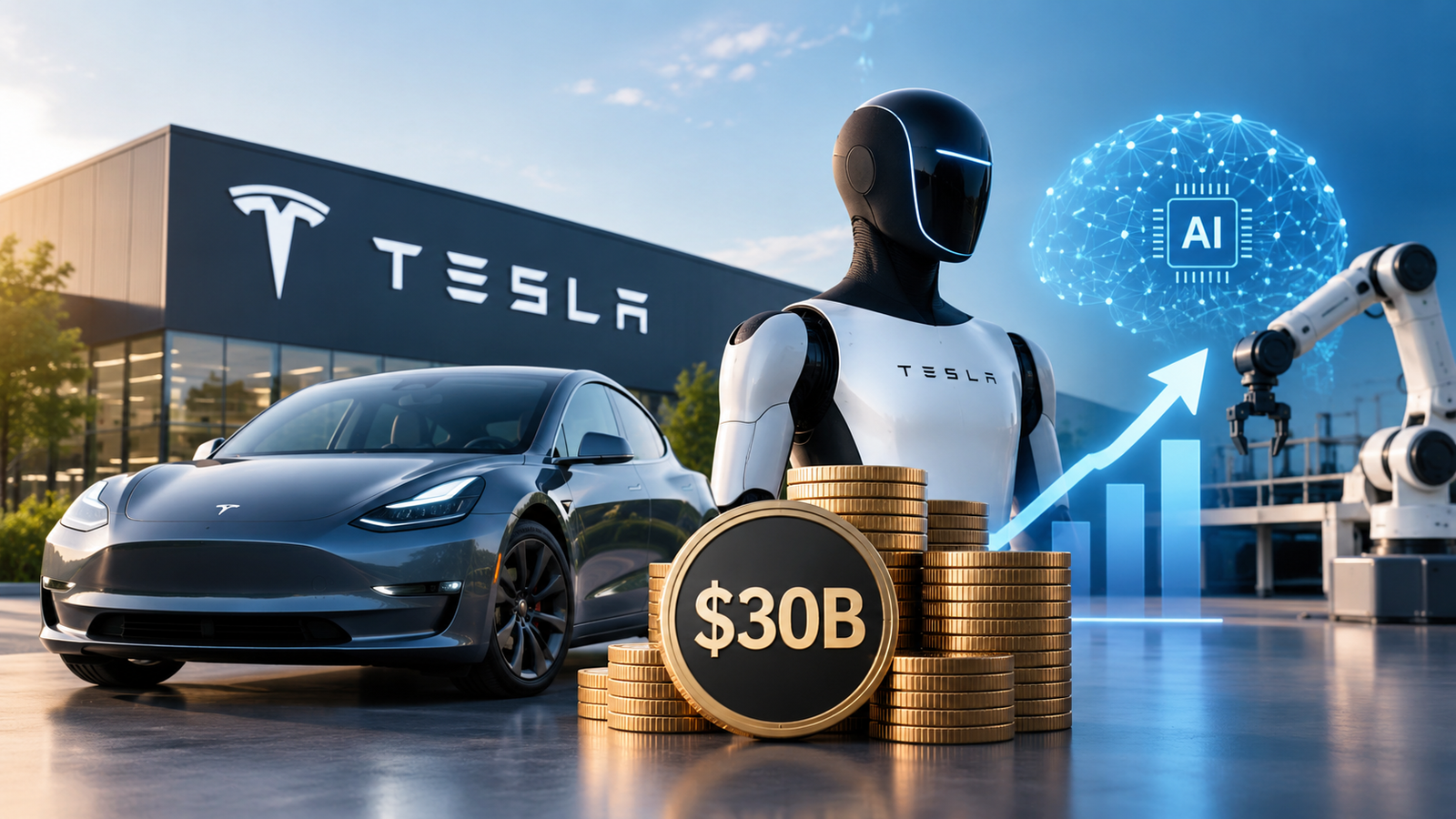
Tesla has secured $30 billion in credit facilities to fund a period of intense investment in artificial intelligence, robotics, and manufacturing technologies.
The new financing, detailed in a filing on September 29, 2026, provides Tesla with significant additional liquidity. Reuters reports that the facilities consist of a $20 billion delayed-draw term loan facility, along with an $8 billion five-year revolving credit facility and a $2 billion short-term revolving facility.
This financing round is notable because Tesla has made ambitious commitments to projects in AI, robotics, and manufacturing that require substantial investment before realizing revenue.
A Large Financial Cushion for Tesla
The new credit facilities do not necessarily imply that Tesla has immediately borrowed $30 billion.
Instead, the structure of the facilities provides Tesla with the ability to borrow against them as needed for its operations. The importance of the facilities stems, in part, from the fact that a credit facility can act as a form of a financial cushion for the business.
Having such a large amount of financing available to the company can be critical to multi-industry concerns like Tesla that operate in several capital-intensive industries.
Reuters notes that the financing is “tied to” Tesla’s overall capital expenditures budget that includes AI computing, solar cell manufacturing, and a semiconductor fabrication project that Tesla is pursuing with SpaceX.
Those are all examples of extremely capital-intensive endeavors that require significant investment before they can generate revenues.
AI Is Becoming a Major Part of Tesla’s Investment Strategy
Artificial intelligence is becoming a significant priority for Tesla.
The company has been working on technologies related to autonomous driving while also making large investments in AI computing infrastructure. Those projects require substantial amounts of capital.
In fact, the intensity of the investment that Tesla is making in AI can be compared to companies in the tech industry that are pursuing similar strategies. The difference is that automakers like Tesla, including Tesla’s CEO Elon Musk, have been particularly vocal about the benefits that they expect AI to bring to the industry.
In other words, Tesla is not alone in its AI investment priorities, but the company appears to be taking a particularly aggressive position.
The Timing of the Financing Is Significant
The timing of the news about the new Tesla credit facilities is also noteworthy because AI investments have become one of the key investment themes in the tech industry.
Notably, Tesla has been one of the most aggressive investors in AI infrastructure among automakers. The reason why AI is so important to Tesla’s strategy is because the company has been planning to introduce fully autonomous vehicles and robots to its product offerings.
In addition to autonomous vehicles, Tesla has been working on the Optimus humanoid robot and the Cybercab robotaxi, both of which are extremely ambitious projects that require substantial investments in AI infrastructure.
Why Robotics Matters
While AI infrastructure investments can be compared to those of other tech companies, Tesla’s plans in the robotics space are unique.
Creating a humanoid robot that can be sold at a price that would make sense from a cost perspective requires substantial investment in research, development, and manufacturing infrastructure. It is one matter to design such a product and it is an altogether different matter to actually manufacture it at a scale comparable to Tesla’s vehicle operations.
In other words, the robotics industry is also extremely capital-intensive, which means that the combination of AI and robotics projects that Tesla pursues will consume a meaningful amount of the company’s financial resources.
Manufacturing Still Matters
That said, Tesla’s capital expenditures are not focused exclusively on robotics and AI. In fact, the company has been quite open about its plans to significantly ramp up manufacturing capacity in order to meet the demand for its vehicles.
Even at this stage, ramping up production still requires significant capex outlays in terms of equipment, battery cells, parts, and materials. In addition to that, Tesla will need to invest heavily in manufacturing solar cells, which is currently a very capital-intensive endeavor.
The $30 billion credit package, therefore, represents a meaningful source of liquidity for Tesla that can be utilized in any of these projects.
Having access to additional financing means that Tesla does not have to rely exclusively on its cash generation capacity to fund its projects, which can be crucial when the company has multiple initiatives that require funding.
The Bigger Story Behind the Financing
With that said, Tesla’s financing story also speaks volumes about the capital expenditures that are required for the next stage in the evolution of the automobile industry.
Simply stated, providing transportation through AI-powered vehicles and/or robots requires a fundamentally different set of infrastructure and capital assets compared to the transportation industry of the past.
More specifically, creating the computing infrastructure that can power advanced AI models, autonomous vehicles, and robotics requires substantial investment. All of those projects are extremely capital-intensive at this stage of their development.
That is why the next step in the evolution of the automobile industry requires substantial investment on the part of companies like Tesla.
What the Credit Facilities Could Mean for Tesla’s Future
Overall, the new credit facilities that Tesla has established give the company substantial flexibility with regard to its future investment plans.
If the company identifies areas of opportunity that it would like to pursue, it can utilize some of the credit facilities, rather than having to arrange for a separate financing package.
At the same time, credit facilities are not free money, which means that Tesla will have to carefully consider its options from here until the point when it utilizes some of the newly established credit facilities.
In effect, the company has more flexibility in its financing strategy, but it does not have a guarantee of success in any of the investment opportunities that it is considering.
A Changing Automotive Industry
Tesla’s strategy also speaks volumes about the transformation that the automobile industry is currently undergoing.
Stay Informed With the Latest & Most Important News
Previous Post
Next Post




Advertisement