

Now Reading: Why the Best Businesses are System Focused, Not Just Customer Focused
-
01
Why the Best Businesses are System Focused, Not Just Customer Focused

Why the Best Businesses are System Focused, Not Just Customer Focused


While there are a number of reasons for any organisation to strive for growth, and a number are directly down to an increase in customers, for many organisations that figure is only part of the puzzle.
An organisation can begin to acquire new customers, but if their systems aren’t designed to properly accommodate that increase, then it can actually create more problems than solutions.
This is why it’s so important, that aside from trying to get more customers, organisations should be taking the time to focus on their systems to see that they’re also prepared to deal with growth.
There’s an important lesson in that for us all
, but as an introduction here’s a brief explanation…
Growth Identifies Weaknesses
Organisations can often get by with simplistic processes in their early days.
The boss knows important customers by name, conversations are conducted via WhatsApp, orders are tracked as best they can, and spreadsheets contain all the information required.
For an organisation that’s not getting an unreasonable amount of customers that’s normally fine, but once they reach a certain size there can be a sudden realisation the things that used to work are no longer sustainable.
The boss can no longer handle personal enquiries, their staff needs better access to information, customers are beginning to become demanding and require quicker responses, and having more orders to process means mistakes are costing them more.
Put simply, growth creates its own pressures – and the easiest way to deal with those is to improve systems.
What Exactly is a System?
It can be a little disheartening to hear there’s another point to growing a business, but there shouldn’t be.
A system is simply an organised method of doing something, and a good system is one that makes a particular process simple to conduct.
It could entail anything from dealing with new enquires,
managing your customer base,
invoices and payments
employee functions
publishing of material
or follow ups among many others
The point all boils down to ensuring something important isn’t reliant upon just one person being able to recite it from memory, because as an organisation grows, that’s going to be difficult to sustain.
Processes Don’t Always Require Technology
There’s no doubt technology has made small businesses far more viable than ever before.
The cloud, customer relationship management, automation, analytics and artificial intelligence all lend themselves well to the small business environment.
However as is always the case with these things, technology should come second to process.
Unless you’re absolutely certain about what it is you need, technology might end up being more of a hindrance instead of a help.
The right process doesn’t always come naturally either, so to address such an issue it’s often best to take note of when something goes wrong.
Did a customer miss out on a proper response?
Maybe the enquiry process needs tweaking. Have staff struggled to find information? Perhaps a new organisational system is needed.
Did a few weeks worth of reports take too long to compile? Some degree of automation might be necessary.
With that said, technology becomes exponentially more valuable the minute you have clear goals.
Enhancing the Customer Journey Through Organisation
Customers will never be aware of the processes behind an organisation, but that doesn’t mean they don’t affect the former.
It’s much more likely a consumer will feel warmly disposed to a company if they know someone else remembers what they told them last time, if their order was efficiently handled, and if they didn’t have to explain the same thing twice in response to a complaint.
Conversely, badly maintained processes tend to lead to customer dissatisfaction.
They’re left in the dark about what’s really going on, they might spend more time telling the company what they want than actually getting it, and important follow ups could disappear down the void if nobody in particular is held accountable for them.
Processes aren’t solely beneficial for customers, however.
Employees will probably have more of a connection with organisational change, but less a sense regarding the necessity for it.
People who know what their responsibility is should never have to second guess what it is they’re supposed to be doing, and having a clearly defined process removes most of that.
A clearly documented procedure can go a very long way in helping to train new staff, and while the latter will inevitably require some investment of time,
it’s easily offset by the fact they don’t spend their own searching for basic information.
With regards to automation as well it’s important to recognise that while it has the means to be incredibly helpful, it’s not always the answer to every conundrum.
If anything automation should merely de-emphasise the necessity for manual operations, while leaving responsibility with actual people, particularly concerning any decisions.
There’s always likely to be a place for routine, emails and reminder notices being good examples, reports, and data entry among some others. However if people are being paid to complete the same actions, then their time would be better spent if those tasks weren’t done manually.
Measuring Issues Before Solving Them
Annoyingly, organisations can quite frequently fix processes without realising they fixed them.
A much better strategy is to have an idea as to where the problems lay in the first place.
How long does it take to respond to an enquiry?
How many enquiries get forgotten about?
If everyone’s spending too much time on preparing reports, weekly figures might actually go down rather than up. Or perhaps people are regularly contacted because they can’t find the right information, or the wrong.
There are a number of ways a company might improve, and while large-scale analysis does have its applications, there’s no substitute for good old fashioned common sense.
Starting Small
As I’m sure any reader will know however, you can’t re-invent the wheel all at once.
The best course of action is always to start with just one process thatneeds work.
The customer journey, invoicing, lead management, stock control, materials production or even office etiquette, all are examples of where changes that seem small don’t have to create too much upheaval.
Once one is clear, the next is easy to work towards
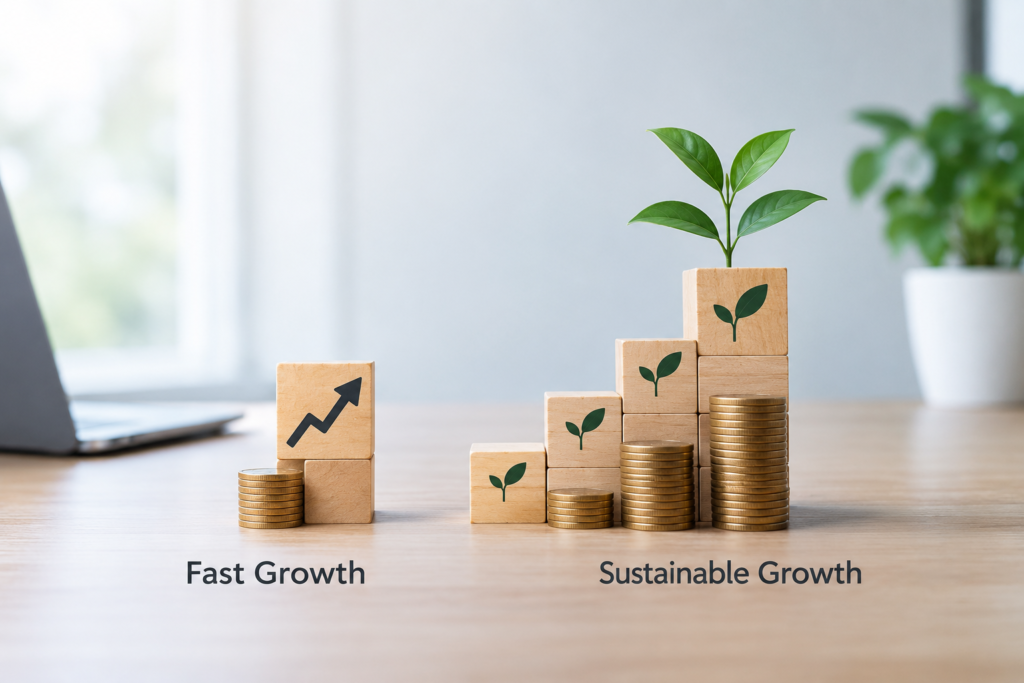
Systems Bring Stability to Growth
One of the biggest problems any organisation faces regarding growth is a lack of stability when something crucial changes.
New hires won’t know anything about the way things work unless it’s properly established, and a critical employee’s absence should never have any impact on something basic.
Now that is not to say everything needs to be rigid, but good organisations will provide structure even where a degree of creativity is required.
The aim isn’t to create a machine-like company, instead we want to de-emphasise the risk of mistakes occurring due to things being kept too casual
The Real Reward to Growth
Revenue, employees, customers and market share are all ways a company can judge its growth, but all of those will be meaningless if there isn’t a real opportunity to improve what comes below them.
If an increase in sales just leads to an increase in demands placed on staff, and things begin to fall apart under the strain, then it’s doubtful any organisation is seeing any real reward for their efforts.
The right systems, automation, effective people management and better organisation can create stability that will allow organisations to thrive on their own accord, and it’s those that typically get noticed the most.
Final Thoughts
While winning customers is important, it’s not a complete enough solution, and those who find themself wanting to move onto bigger and better things tend to find they hit a brick wall with little to offer.
This is why it’s always crucial to ensure that aside from bringing in more business, a company puts effort into growing accordingly
Is a team there to make things happen, or is important data difficult to obtain and use? Do people know what they’re supposed to be doing, or is there too much repetition? Can someone else replicate a process, or does the knowledge of any one individual carry its own risks?
These and similar questions tend to be more important than trying to figure out exactly how to win more customers.
Related Posts


Stay Informed With the Latest & Most Important News
Previous Post
Next Post



Advertisement