

Now Reading: Difference Between What vs. Which: An English Grammar Question
-
01
Difference Between What vs. Which: An English Grammar Question


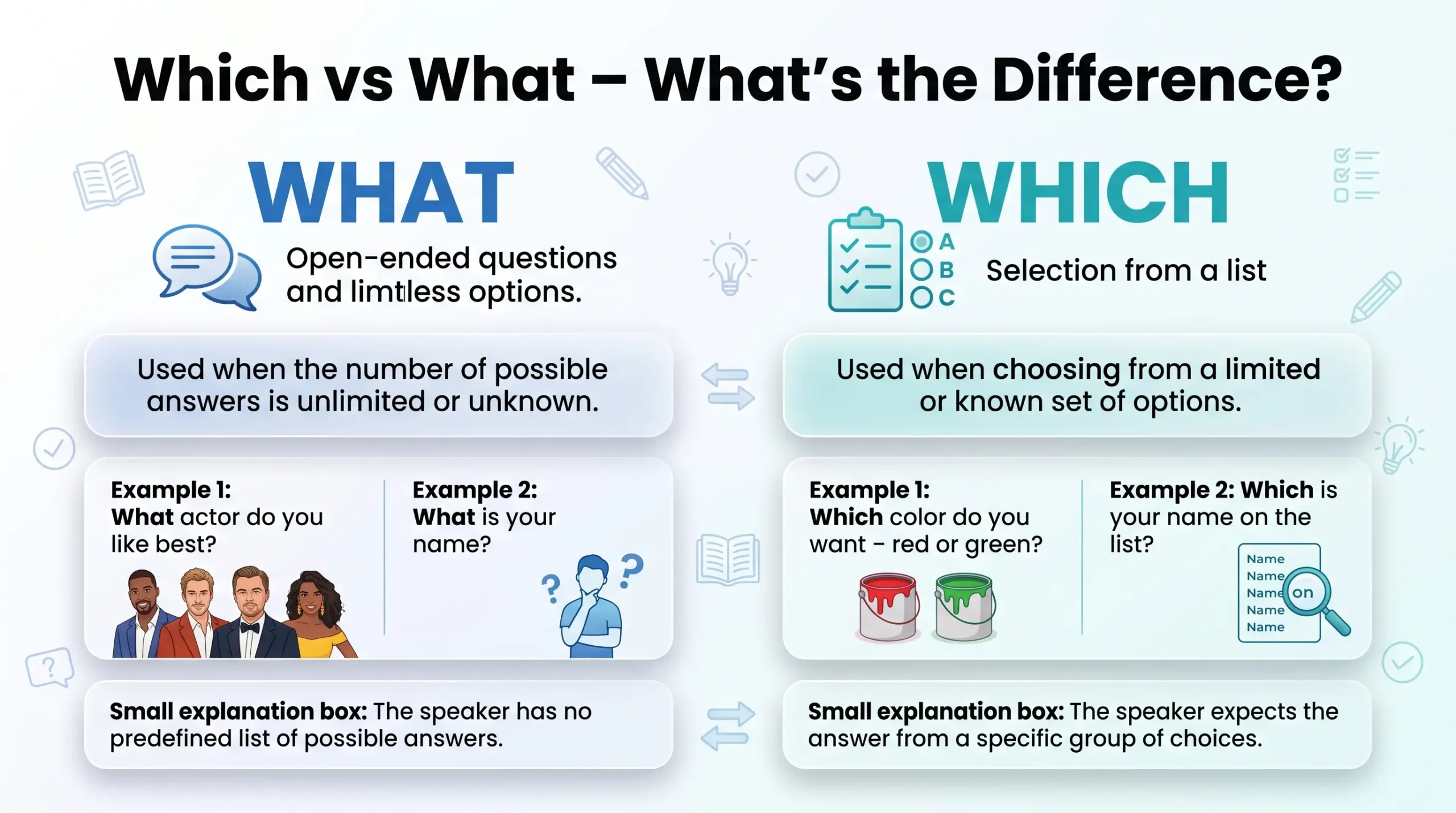
Navigating the nuances of English grammar can often present intriguing challenges, especially when it comes to distinguishing between seemingly similar question words like “what” and “which.” This article aims to clarify the difference, offering a comprehensive guide to their correct usage as interrogative pronouns and determiners. By exploring their contextual applications, we will delve into how these words influence the meaning and scope of a question, helping you confidently choose the appropriate term in various situations.
Understanding the Question
Defining “What” and “Which”
“What” and “which” are two significant “wh-” words in English grammar, frequently causing confusion due to their overlapping uses and meanings. Both function as interrogative pronouns and can also serve as determiners, but their fundamental difference lies in the breadth of options they imply. “What” is used as an interrogative to refer to an essentially unlimited set of options, making it suitable for broad inquiries. Conversely, “which” refers to a narrower or limited set, implying a specific choice from a predefined group. While both work for objects, qualities, or places, it’s important to remember that for people, one generally uses “who.” The key distinction truly boils down to the number of possibilities available and the existing background knowledge of those options.
Contextual Usage
The choice between “what” and “which” is heavily dependent on the context of the sentence, influencing the meaning and expected answer. “Which” often sounds more formal when used to ask a question requiring a choice between a specific, limited number of items, implying a known set of options to the speaker. While you can often replace “which” with “what” and remain grammatically correct, the reverse is not always true, as “which” inherently demands a context of choice. We generally use “which” when asking about a fixed or limited number of things or people, and “what” when the options are not limited or known. However, in many situations, it’s possible to use either “which” or “what” with only a subtle difference in meaning.
Common Misconceptions
A common misconception is that “which” can be used in any question, but it strictly works in the context of being presented with choices. For example, “What of your shirts are you considering for the photo?” makes no sense; the correct usage would be “Which of your shirts…”. Choosing “which” implies the speaker already possesses some background knowledge or information about the options, and using it without such knowledge can sometimes sound socially awkward. Because “which” refers to more limited options, the answers received to interrogative questions using this pronoun are also typically more limited and specific, guiding the conversation towards a focused response.
Relative Pronouns Explained
The Role of Pronouns in Grammar
Pronouns play an essential role in English grammar, functioning to replace nouns and avoid repetition within a sentence. Among these, relative pronouns are particularly significant as they introduce relative clauses, which provide additional information about a noun or pronoun mentioned in the main clause. These clauses, acting as adjectives, modify and describe the preceding noun or pronoun. Dependent clauses are often marked by the use of subordinating conjunctions or relative pronouns, indicating their reliance on the main clause for complete meaning. Both restrictive clauses and nonrestrictive clauses are types of relative clauses, each serving a distinct purpose in clarifying the subject of a sentence.
Examples of Relative Pronouns
To better understand their function, it’s helpful to consider various examples of relative pronouns. Common relative pronouns in English include “that,” “which,” and “who.” For instance, in the sentence, “The book that I read was fascinating,” “that” is a relative pronoun introducing a restrictive clause that specifies which book is being discussed. Similarly, in “My brother, who lives in London, visited last week,” “who” introduces a nonrestrictive clause, adding extra information about the brother. Understanding these examples is crucial for correctly constructing complex sentences and expressing nuanced ideas within English grammar.
When to Use “What” vs. “Which”
The choice between “what” vs. “which” is a frequent grammar question that often comes down to the number of options available and the background information the speaker possesses. You generally use “what” when there are many possible options or when you don’t know how many options there are, implying a broad inquiry. In contrast, “which” indicates a more limited set of options, suggesting that you already know the answer is one of a few specific things. Knowing how to use “which” in a question means thinking about how much you already know; using it implies some existing background knowledge. The word ‘which’ tends to pertain to a more limited and less open ended basket than the word ‘what’, making it a more precise style choice when both words could grammatically work. “Which” is used for specified sets of items or implied sets, whereas “what” is used for nonspecified sets, clearly highlighting their fundamental difference in usage.
Grammar Rules and Correct Usage
Determiners in English
As determiners in English grammar, “what” and “which” are often used almost interchangeably with subtle differences in meaning. “What” functions as a question word when referring to a nondefined or unlimited set of items, whereas “which” often refers to predefined or implied sets of items, suggesting a more limited choice. Both can also be used as relative determiners, linking clauses and providing additional information, making their precise application dependent on the context and the speaker’s assumed background knowledge regarding the set of options.
Points to Remember
When deciding between “what” and “which,” a useful trick is to try adding the words “of your” or “of” followed by another pronoun immediately after the word in question. If that construction sounds grammatically correct and coherent, “which” is generally the better choice, indicating a selection from a specific or limited set of options. This mental check helps clarify whether the intent is to inquire broadly or to make a choice from a known and constrained group of items.
Practical Examples and Exercises
Consider “Which/What flavor of ice cream do you want?” While either works, “which” is often preferred when presented with a known list of flavors, implying a specific choice from that limited set. In contrast, “What do you want for dessert?” asks broadly without a predefined menu. “What towns do we go through?” implies the speaker has no background knowledge, while “Which towns do we go through?” suggests familiarity with the area. Another example: “I don’t know which words are funny and which are not” implies a specific set of words, whereas “I don’t know what words are funny and what are not” implies a general struggle to distinguish humor.
Conclusion and Final Thoughts
Summary of Key Differences
To summarize, the core difference between “what” and “which” lies in the scope of options they imply. “What” refers to an essentially unlimited or nonspecified set of options, making it suitable for broad inquiries. Conversely, “which” refers to a narrower, limited, or implied set of items, guiding the answer towards a more specific choice. Furthermore, “what” can function as a determiner, pronoun, and interjection, while “which” is primarily used as a determiner and pronoun, offering distinct grammatical roles in English sentences.
Importance of Correct Usage
Understanding the subtle difference and correctly choosing between “what” vs. “which” is essential for effective communication in English grammar. This choice allows the speaker to express themselves clearly and precisely, ensuring that the listener or reader accurately interprets the intended meaning of the sentence. By mastering this nuance, one can avoid misunderstandings and convey information with greater accuracy, especially when people are reading between the lines and inferring details from your word choice.
Further Resources for Learning
For those seeking to deepen their understanding of “what” vs. “which” and other intricate aspects of English grammar, numerous online platforms, grammar guides, and language learning applications offer extensive resources. Websites dedicated to grammar rules provide detailed explanations and interactive exercises, while dictionaries often include usage notes for tricky words. Engaging with these materials can significantly enhance one’s proficiency in choosing the correct word for various situations, bolstering overall English communication skills.
Related Posts



Stay Informed With the Latest & Most Important News
Previous Post
Next Post




Advertisement